It seems that spectacles and sunglasses are among the most commonly lost items that people want back. Sadly, there’s also a high disposal rate of these items, meaning they’re rarely returned to their owner. Many make it into the ‘secondary market’ often overseas, so at least someone benefits, even if it’s not you.

Working on a solution we think you’ll like!

[update] Check out this article on how to use WhosMyOwner to protect your glasses!

You don’t NEED WhosMyOwner OR Insurance.  Not really.   But both serve a purpose when it comes to lost property.

As long as your insurance policy actually covers a particular loss, it may pay out towards the cost of replacement.

But… insurance is subject to all sorts of rules and loopholes, like voluntary excess payments, excluded items or extra surcharges for loss of property.  If you’ve never looked into the cost of insuring a recent iPhone for a year, it’s educational.  Then add in the surcharge most companies require to cover loss as well as damage.  And check for small print about Acts of God, own-fault incidents, lack of supporting evidence / receipts / police reports.

WhosMyOwner doesn’t help with your costs of replacement; it tries to avoid the need for replacement completely!  We simply give anyone finding your property an easy way to get it back to you.  And in most cases, they will.

WhosMyOwner is quite simply better value than insurance.  It’s quick, inexpensive and has no hidden costs, no paperwork, exclusions or delays.

 

Sure, but then it wouldn’t be private.

The more personal information you put ‘out there’ the more likely you are to receive unwanted messages.

If you put any personal details on a key ring, then lose it  while travelling, whoever finds it has your keys, and knows you’re away from home for a while.  If those keys never show up, you’ll know they’re still out there, somewhere.  Isn’t it worth securely tagging them to avoid that risk?

You could use an email address or phone number instead.  But if those depend on you staying with your current ISP or mobile provider, or employer, then leaving any one of those renders all your labels useless.

Your WhosMyOwner tag is yours for as long as your account is active, and changing your contact details has no effect on it (just update your account when you can).

Tagged with:

Our members are extremely creative – we’re constantly impressed.

Lots of people are tagging their iOS devices simply by taking a picture of a hand-written or printed note, or a label bearing their tag.  They then make that photo their lock-screen image.  If someone finds and turns on their device, they’ll see the tag and instructions.

Most people also put a label on their smartphone.  It’s such an expensive item and usually contains data as well, that it’s the worst possible thing to lose.  If you don’t like the idea of spoiling the look of your mobile with a sticky label, put it on the back and inside the cover.

For travel, people are putting tag labels on the back of their passport.  (If you lose your passport in the airport, would you know how to find it?)

You could also…

  • Engrave many metal gadgets, like iPhones, iPads etc.
  • Insert a business card sized card bearing your tag and instructions in your bag, wallet, purse, travel pouch, coat pockets
  • Use an online image generator (like this one) to create an image with your tag and use it as your phone’s wallpaper or lock screen
  • Log into your WhosMyOwner account, go to the Labels page and print personalised labels onto Avery label paper
  • Label everything you care about that you’re taking to big public events, like summer music festivals and sports events
  • Print out your tag and our URL clearly in big print, and take a photo of it with your digital camera.  Leave it on the camera permanently
  • Write your tag and our URL on coat labels using a fabric marker, or iron-on tape.

We look forward to hearing your  ideas.


Yes!

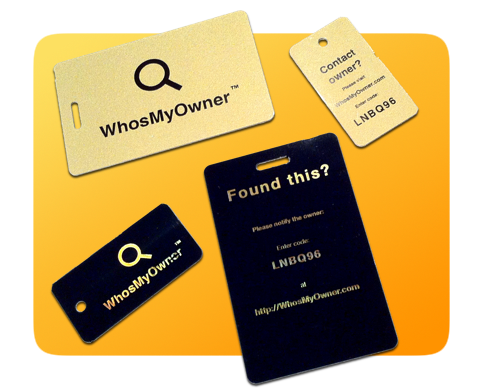
Just order our Startup Pack online.  It contains a set of key fobs and luggage tags in a choice of designs (examples below).  Anyone with an email address can activate them.   We’ll deliver them to you, and you can give them to anyone you like.

It’s entirely up to you and the Owner to agree on how the item will change hands.

If you’ve no reason to return the item in person, it’s usually much more convenient for you to pick a police station (or hotel / office / gym / building reception, station lost property office, etc.) near where you found the item, and just notify the owner so they can collect it from there.

We always recommend this method if you’re at all unsure about meeting the Owner in person.

In some cases, you might prefer to post the item.  If so, one possibility is to list it for sale on an online auction, specify the postage cost and let the Owner “buy” the item as a Buy it Now listing, and cover your postage cost.  This also ensures that there’s a record of the transaction, and if  both parties are auction site members, they will likely try hard to protect their reputations.  Any reward could be specified as the Buy it Now price in the listing.  You can send the listing details to the Owner using a WhosMyOwner Finder Report, so they can buy it instantly.   You must be prepared to part with the item at the Buy it Now price, even if someone else buys it.


Tagged with:

This is entirely up to what’s convenient for both you and the Finder.  Remember they’re doing you a favour by returning your item, so as the Owner it’s a good idea to go along with their suggestion.  However, we can’t stress enough that if you’re uncomfortable with the Finder’s suggestion for meeting up to hand back your item, you should ask them to leave it at any police station, and notify you which one it’s at.

Tagged with: